Locations Groningen - Friesland - Drenthe - Overijssel - Flevoland - Gelderland - Utrecht - Noord-Holland - Zuid-Holland - Zeeland - Noord-Brabant - Limburg - Amsterdam - Rotterdam - Den Haag - Netherlands Antilles - Surinam - Australia - Canada - Germany - Ghana - Taiwan - USA
Topics Baptists - Dates and times - Dutch food - Dutch history - Dutch language - Dutch names - Emigration - Early Dutch settlers - Ellis Island - Holland America Line - New to Dutch genealogy - Newsletter - Online genealogy - Pitfalls - Sources - Wilhelminakade - Wie was wie


Tombstone Tuesday: War graves in the dunes

On many genealogy blogs, Tuesday is Tombstone Tuesday - bloggers share photos of their ancestors' tombs, or otherwise write cemetery related blog posts. On Tombstone Tuesdays, Trace your Dutch roots posts articles related to Dutch cemeteries, burial practices, or individual graves. Today: A war cemetery in the dunes.

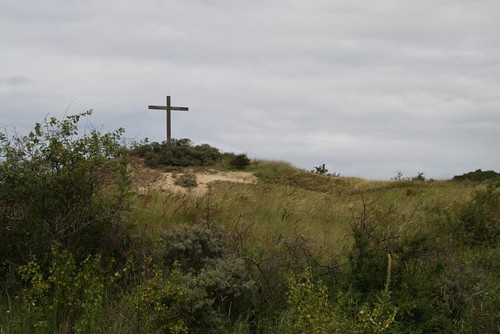
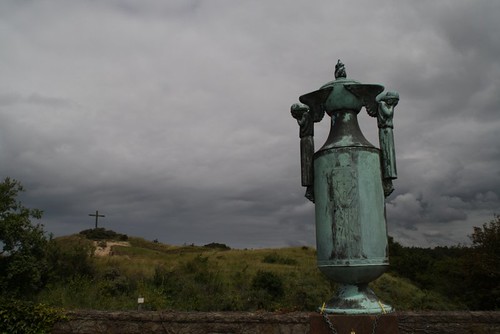
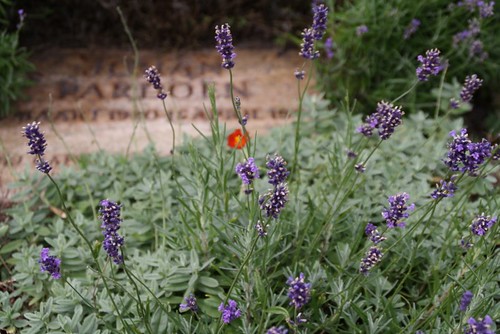
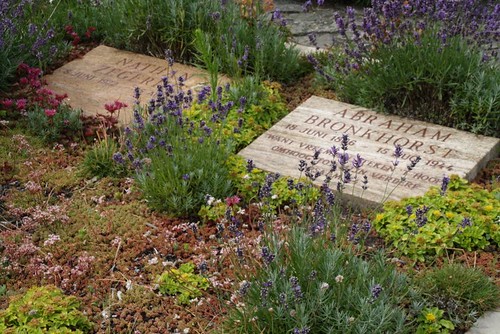
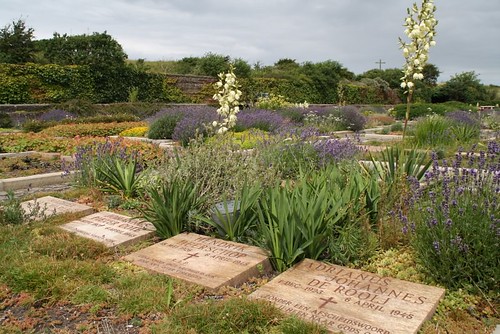
This small but beautiful cemetery, in the dunes of the national park Zuid-Kennemerland, is the final resting place of 373 resistance fighters who gave their lives in the second world war. Many of these resistance fighters were caught, taken to the dunes, and executed by a firing squad. Their bodies were left behind, or buried on the spot. After the war they were reburied here.

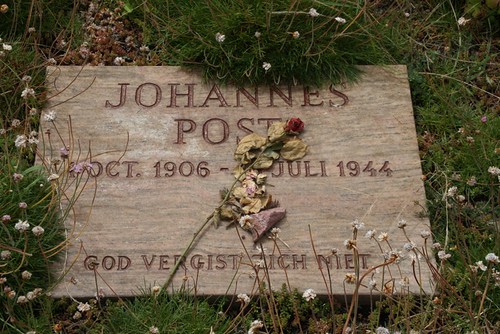
Among the people buried here are a few people of renown (at least in Holland), like Hannie Schaft (the only woman buried here), Gerrit van der Veen, Johannes Post, and Walraven van Hall.

The cemetery is an erebegraafplaats (cemetery of honour), which is the equivalent of a military cemetery for civilians.

Cemetery of Honour

Cemetery of Honour

Cemetery of Honour

Cemetery of Honour

Cemetery of Honour

Cemetery of Honour

Labels: , ,

1 Comments:

Blogger Peter said...

I've been there, it is one of the most beautiful cemeteries in Holland. The reason it is there is not so beautiful, to put it mildly.


Post a Comment

<< Home

The cemetery of Witteveen

On many genealogy blogs, Tuesday is Tombstone Tuesday - bloggers share photos of their ancestors' tombs, or otherwise write cemetery related blog posts. On Tombstone Tuesdays, Trace your Dutch roots posts articles related to Dutch cemeteries, burial practices, or individual graves. Today: A photo impression of the cemetery of Witteveen.

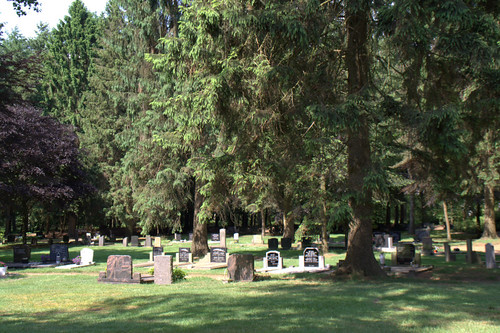
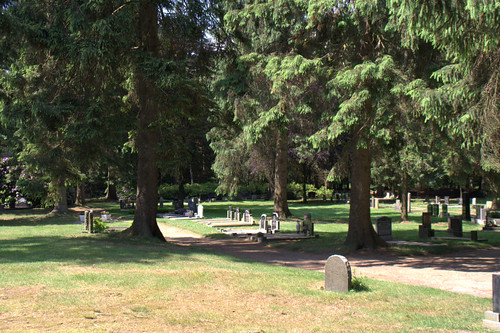
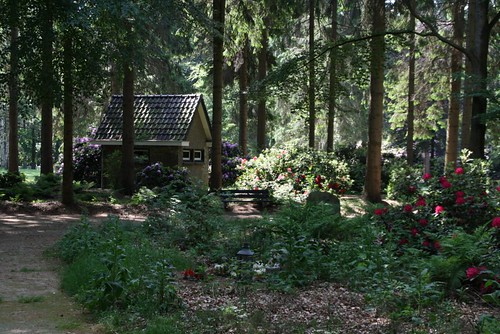
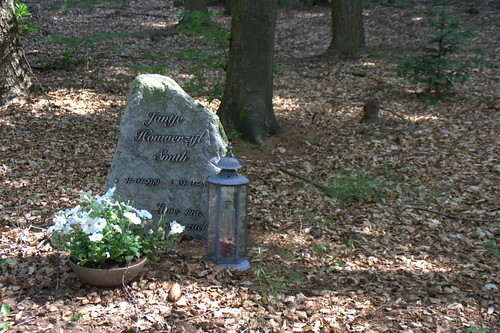
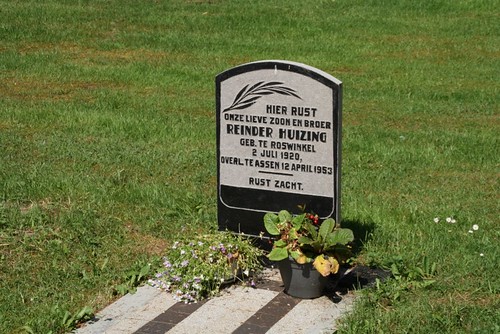
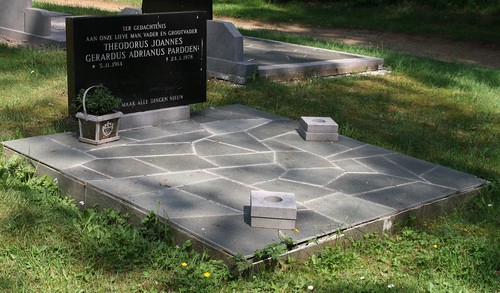
Witteveen is a small village in the rural province Drenthe. It was founded in 1926, for laborers from Dutch cities who settled here for work procurement projects. I recently visited their cemetery, on a quiet spot just outside the village. Below I share a photo impression of this beautiful rural Dutch cemetery.

Witteveen cemetery

Witteveen cemetery

Witteveen cemetery

Witteveen cemetery

Witteveen cemetery

Witteveen cemetery

Witteveen cemetery

Labels: , ,

0 Comments:

Post a Comment

<< Home

Tombstone Tuesday: The grave of Johannes Vermeer


Johannes Vermeer, the celebrated painter of masterpieces like Girl with a pearl earring, The Milkmaid, and The Little Street, is buried in the Oude Kerk (Old Church) in Delft.

On the photo below you can see his grave. Originally his grave was unmarked, this stone was placed only a few years ago. Vermeer was Lid van het Sint-Lucasgilde, member of the Guild of Saint Luke. The image at the bottom of the stone is the guild's seal.


Girl with the pearl earring

Labels: , , , ,

0 Comments:

Post a Comment

<< Home

Tombstone Tuesday: A few graves in the St Bavo church in Haarlem

In medieval and early modern times, our Dutch ancestors (and many other Europeans) buried their death in, under and around their churches. Those who could afford it had a memorial, often in the form of an inscription on their grave. If you visit an old Dutch church, you are often walking over the graves. Look down, at the floor of the church, and you may see the inscriptions, sometimes worn away after centuries of walking over them, sometimes surprisingly well kept, sometimes restored recently to their former glory.

Last month I visited the St Bavo Church in Haarlem, province Noord-Holland. Today, I share a few of the grave memorials that I saw there.
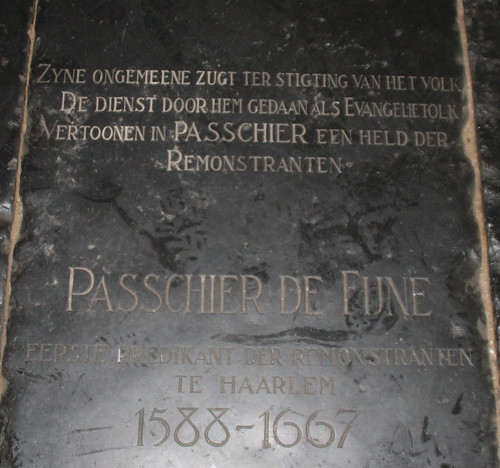
Grave in the St Bavo Church, Haarlem, The Netherlands

The first grave belongs to Passchier de Fijne, a pastor of the Remonstrants in the 17th century. The (Dutch) inscription:

Zyne ongemeene zugt ter stigting van het volk De dienst door hem gedaan als Evangelietolk Vertoonen in PASSCHIER een held der Remonstranten Passchier de Fijne Eerste predikant der Remonstranten te Haarlem 1588-1667

His uncommon drive to edify the people / The service done by him as preacher of the Gospel / Make PASSCHIER a hero of the Remonstrants.

Passchier de Fijne, First pastor of the Remonstrants in Haarlem, 1588-1667.
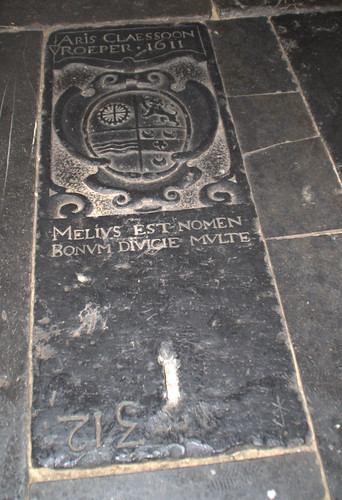
Grave in the St Bavo Church, Haarlem, The Netherlands

The next grave belongs to Aris Claessoon Vroeper, who was apparently buried here in 1611. His epitaph (in Latin) is Melius est nomen / Bonum divicie multe, which I think means: A good name is better than many riches. Please leave a comment below if you know the meaning or origin of this epitaph.

I don't know anything about the occupant of this grave. If you do, please let me know.
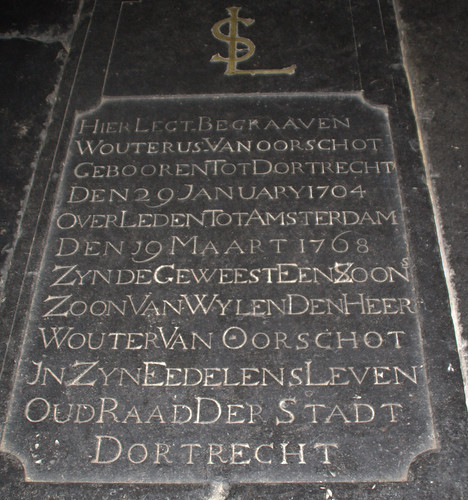
Grave in the St Bavo Church, Haarlem, The Netherlands

Next up: Wouterus van Oorschot. His inscription (in Dutch):

Hier legt begraaven Wouterus van Oorschot, gebooren tot Dortrecht den 29 January 1704, overleden tot Amsterdam den 19 Maart 1768, zijnde geweest een Zoons Zoon van Wylen den Heer Wouter van Oorschot, in zyn Eedelens Leven Oud Raad der Stadt Dortrecht.

Rough translation: Here lies buried Wouterus van Oorschot, born in Dordrecht 29 January 1704, died in Amsterdam 19 March 1768, having been a son's son of the late sir Wouter van Oorschot, who was in His Honourable's life former council of the city Dordrecht.

It seems that Wouterus' main claim to fame was the fact that he was the grandson of Wouter van Oorschot, who was probably well-known at the time, but now forgotten. Wouterus' name still lives on in the Hofje van Oorschot, a courtyard surrounded by almshouses in Haarlem, which was built after his death and largely financed out of his estate.
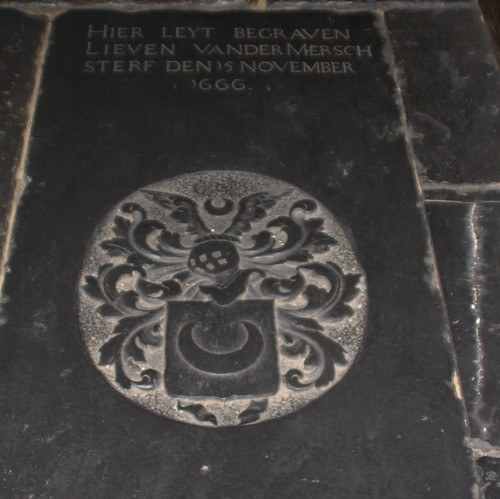
Grave in the St Bavo Church, Haarlem, The Netherlands

Grave in the St Bavo Church, Haarlem, The Netherlands

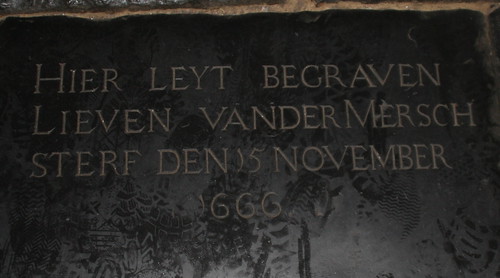
Hier leyt begraven Lieven van der Mersch sterf den 15 November 1666 (Here lies buried Lieven van der Mersch died 15 November 1666). I don't know anything about this person, but there is a genealogy of Lieven van der Mersch online.

In the closeup photo of the tombstone you can clearly see footprints: The floor of this part of the church is covered with tombstones, so church-goers have no choice but to walk over the graves.
Grave in the St Bavo Church, Haarlem, The Netherlands

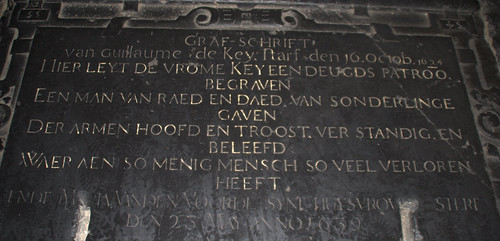
The last tombstone I present today is that of Guillaume de Key and his wife Maria van den Voorde. Searching Google I found some genealogical data about this couple (I did not verify anything, so use at your own risk). Let's have a look at the text on his stone:

Grafschrift van Guillaume de Key, starf den 16. Octob[er] 1624 Hier leyt de vrome Key een deugds patroo[n] begraven Een man van raed en daed, van sonderlinge gaven Der armen hoofd en troost, verstandig en beleefd Waer aen so menig mensch so veel verloren heeft. Ende Maria van den Voorde syne huysvrouw sterf den 23 May anno 1639.

Rough translation (without the rhyme that is present in the Dutch text): Epitaph / of Guillaume de Key, died 16 October 1624 / Here lies buried the pious Key, a patron of virtue / A man of word and deed, of extraordinary talents / Head and comfort of the poor, sensible and polite / In whom so many people lost so much. The last part of the inscription was added later: And also Maria van den Voorde, his wife, died 23 May 1639.

Labels: , , ,

1 Comments:

Anonymous Anonymous said...

Very nice!
Some of my ancestors came from Flandres (Belgium) and Netherlands. Jaques van Kampen, for exemple, came from a place called Kampen or Campen in Netherlands. In Portugal, where he lived till his death, in 1621, he was called Jaques de Campos, a famous artist in Lisbon. He appears in the book "Een Kamper Handelshuis te Lissabon 1572 1594" by J. Nanninga Uitterdijk.
So, always good to learn about our dutch roots.
Good work and best wishes.
Felipe Leite van der Borg


Post a Comment

<< Home

Graveyard Rabbit

You may have noticed the new link in the sidebar, or read the announcement in the newsletter. For those of you who missed it, I repeat the announcement here:

Terry Thornton, author of Hill Country of Monroe, Mississippi, recently founded The Association of Graveyard Rabbits. The goal of the association is to promote "the historical importance of cemeteries, grave markers, and the family history to be learned from a study of burial customs, burying grounds, and tombstones". Members are required to have their own membership blog, where they engage in "the study of cemeteries, the preservation of cemeteries, and the transcription of genealogical/historical information written in cemeteries".

I am a charter member of the Association. My membership blog is The Graveyard rabbit of Utrecht and Het Gooi. On this blog, I will post photo impressions of cemeteries in the Utrecht and Het Gooi regions and write about Dutch burial customs and Dutch cemeteries and their "inhabitants", often with a focus on the Utrecht and Het Gooi regions. [...]

Visit The Graveyard Rabbit for a list of members and their blogs. Most members focus on a region in North America. At the moment, I am the only Dutch graveyard rabbit.

Until 1 November 2008, membership of the Association is open, visit The Graveyard Rabbit for more information. From 1 November, membership is by invitation only.

Labels: , ,

1 Comments:

Blogger Terry Thornton said...

Henk, Thanks for mentioning The Association of Graveyard Rabbits and the links --- but more important, thanks for joining the association. I look forward to reading more of your articles at your Graveyard Rabbit blog from the central regions of The Netherlands.

Terry Thornton
Fulton, Mississippi USA


Post a Comment

<< Home